
Agnipath offers jobs to youngsters between 17.5 years and 23 years of age. The unemployment rate in this age group has risen from around 23% in 2017 to over 50% since 2020. Every second person who is looking for employment in this age group is unemployed, explains Mahesh Vyas.

'When women act assertively, express anger or vocalise their accomplishments -- examples of characteristics that are seen among leaders in most organisations -- they often receive pushback because these behaviours do not align with traditionally feminine attributes.'

'Is a rapidly growing working-age population a prerequisite for growth or a social tinderbox?'

One popular strategy is to hire contract workers.

Is India witnessing jobless growth or is there actually no issue with employment? The real story is between the first two suggesting that though there is sufficient employment, the challenge is to create well-paying quality jobs, says Amitabh Kant.

This is the full text of the address to the nation by President Droupadi Murmu on the eve of India's 78th Independence Day.

India is ranked lower than all its BRICS peers -- Russia, China, Brazil and South Africa

What is more worrying, according to the report, is the fact that in over 20 per cent of the topic caseload districts where the second has ebbed, the third wave has set in firmly, which was only 5 per cent a month ago.

Failure to reinstate salary even two years after the drastic cuts has landed the airline industry in a massive industrial relation crisis. While employees of Air India had organised a strike back in 2011, it is for the first time that private airlines are facing serious stress related to workers. IndiGo witnessed two of them, back to back. In the first instance, around 50 per cent of the IndiGo flights were delayed as a large number of crew members went on mass sick leave, apparently to participate in a rival airline's walk-in job interview.

'The power sector accounts for much of the financial burden of state governments in India.'

American economic historian and labour economist Claudia Goldin won the 2023 Nobel Economics Prize for her work examining wage inequality between men and women, the Royal Swedish Academy of Sciences said on Monday. The Sveriges Riksbank Prize in Economic Sciences in Memory of Alfred Nobel 2023 was awarded to 77-year-old Claudia Goldin "for having advanced our understanding of women's labour market outcomes" the prize-giving body said in a statement. Goldin will receive 11 million Swedish kronor, or around $1 million, as the sole winner of this year's prize.

Why did Karnataka's economic prosperity fail to influence the nature of electoral promises made by political parties in the run-up to the assembly elections? asks A K Bhattacharya.

India has performed poorly in removing gender-based disparities, ranking 114 out of 142 countries in World Economic Forum's 2014 gender gap index, scoring below average on parameters like economic participation, educational attainment and health and survival.

Marriage is the most common purpose of migration, with 49 per cent migrating for marriage, followed by moving with households (15 per cent) and work/employment (10 per cent), discovers Devanik Saha.

How soon can India reach a point when there is no hidden underemployment and all who want work can find it at a fair wage and decent work conditions, asks Nitin Desai.
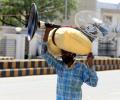
'In difficult times as now, the call of the village is all that these migrants can hear,' observes Vijaya Pushkarna.

Any narrative against the Dravidian model may impact the BJP's prospects in Tamil Nadu. This may explain why the BJP in Tamil Nadu is placing more emphasis on corruption allegations against the DMK, even as the party focuses nationally on the Sanatana controversy.

The elements are all aligned to make India a global powerhouse, says IMF Managing Director Christine Lagarde.

'You have to have commitment to both, but it has to be done at the individual level.'

'The new government will have to contend with slowing economic growth, weak private investment, anaemic exports and vulnerable external imbalances, a stressed financial system, mounting fiscal pressures (including high government debt-to-GDP ratios) and an exceptionally bad employment situation,' says Shankar Acharya, former chief economic adviser to the Government of India.

The government has to cover a lot of ground if it wants to achieve the target of generating 10 million new jobs in the sector over the next three years, says Shyamal Majumdar.

The report has identified some areas that need attention from India's policymakers.

This could be a major drag, not just on the empowerment of women but on the India growth story as well.

Given the rapid changes in the Indian labour market, there is an urgent need to have current, accurate and publicly available data through regular, dynamic and comprehensive surveys. Indeed, this was the intention behind constituting the NITI Aayog Task Force on Improving Employment Data. The attempts by the government to "improve" labour data has actually made it worse, say Rosa Abraham, Janaki Shibu & Rajendran Narayanan.

Within six months, outlets carrying Vicks jumped from 60,000 pharmacies to 750,000 general stores. The trade boycott collapsed. Consumers were happy, finding Vicks now at every street corner. A fascinating excerpt from Gurcharan Das's Another Sort of Freedom.

India's per capita GDP of $5,238 in 2013 was 65 per cent lower than Iran, 54 per cent lower than Maldives, 44 per cent lower than Sri Lanka and 27 per cent lower than Bhutan, according to the Human Development Report 2015

'Aggressively stepping up vaccinations will constitute the most enduring stimulus of all in the coming quarters,' observes Sajjid Z Chinoy, Chief India Economist at J P Morgan.

Making employers provide creche facilities would be a powerful incentive for women to stay on in the workforce rather than drop out owing to the pressure of child care, says Shuma Raha.
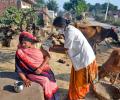
'We are today worse off today compared to where we were two years ago by as much as 43 per cent,' notes Mahesh Vyas.

That is what you will hear again after Nirmala Sitharaman presents a speech that will prove to be meaningless and numbers that will show themselves to be wildly off the mark, observes Aakar Patel.

With longer work hours and a work from home set-up during the COVID-19 pandemic, women bore the maximum brunt by performing a dual role as a working professional as well as a caregiver.
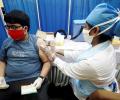
The cost of not vaccinating the entire population quickly will be far higher than bearing the entire cost of vaccination, points out Prosenjit Datta.

Can 3 crore out of the 8.9 crore young male population of the nine states set off on a pilgrimage that extends for about a month? If yes, then what can we infer regarding the state of the young working population in these states, asks Mahesh Vyas.

The biggest loss of jobs among salaried employees was of 'white-collar professional employees and other employees'. Among these are engineers including software engineers, physicians, teachers, accountants, analysts and so on, who are professionally qualified and are employed in some private or government organisation All the gains made in their employment over the past four years were washed away during the lockdown, reveals Mahesh Vyas.

Indian women have education, inspiration and perspiration -- but not enough employment, points out Mahesh Vyas.
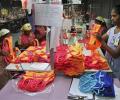
Reasons include include dropping out of education, raising children and family pressure
A report by the Azim Premji University showed that during the pandemic 270 million Indians were pushed into poverty. Meaning that they were not poor according to the government poverty line before, but have become now. Aakar Patel mulls on the state of the nation as the Modi government enters its eighth year.

If everyone had decent meaningful jobs, the rally maidans would be largely empty and, save for the Akhara babas and curious foreigners and the devout senior citizens, not very many would spare time for the Kumbh Mela, says Mahesh Vyas.

India ranks low at 105th on human capital index, Finland tops

India retains the tag of the fastest growing country among the world's major emerging economies
